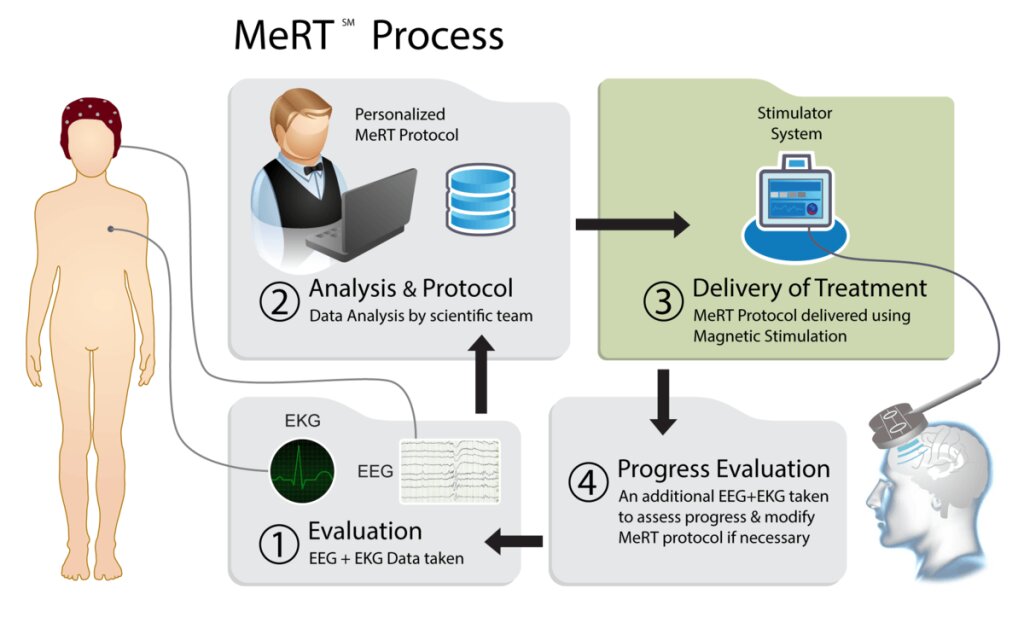
MeRT therapy at Brain Treatment Center Danville is changing the way we approach brain health. This cutting-edge technology combines qEEG, EKG, and rTMS to build a custom-fit treatment protocol designed to restore healthy brain communication.
What makes MeRT unique is that it is highly customized for each individual based on sophisticated diagnostics. Since every brain is unique, no treatment is the same.
MeRT is non-surgical, non-invasive, and non-pharmaceutical.

What conditions does MeRT treat?
How it works
The Four Steps to MeRT
Benefits of MeRT can include the following:

Dr. Erik Won, President of Wave Neuroscience
“What we’ve learned is that everyone has a unique frequency or unique signature.”
“All of us during our wakeful hours, [has] something called an Alpha frequency where our brain most comfortably operates. It’s a cycle rate where we’re all somewhere between 8 and 13 Hertz. And you might be, for example, an 11.4 Hertz brain. I might be an 8.9 Hertz brain. And somebody else might be a 10.3 Hertz brain. It’s just kind of where were born.”
“But when we get these brain images, whether it’s through the physical trauma of a blast injury, or the chemical trauma of years of drug use, or the emotional trauma of seeing a loved one pass away, we may find areas of the brain that are not cycling at the same rate as the rest of our cortex area that’s not working properly and try to stimulate it and remind it that it wants to fire at a certain frequency and a certain rate.”
“Trauma is not just an internal, ethereal, emotional thing – but there’s actual parts of the brain where you can see that it actually had an impact. EEG’s, or electrical images of the brain, can tell us when there are abnormalities in neural networks – we can see for example if nobody has an area in the left prefrontal cortex that is cycling at 2 Hertz which means that part of the brain may only be processing information at a rate of 2 times/ second whereas the rest of your brain may be cycling at 11 Hertz or 11 times/second which means that information mismatch may manifest for someone as depression, they may lack motivation, feel lethargic, not want to get out of bed, but in a different scenario it may manifest as anxiety. Nobody has a perfect brain, for the most part we can look at these signals and find areas that are abnormal, and navigate to the area that’s not working properly, try to stimulate it, and again remind it that it wants to fire at a certain frequency and at a certain rate.”
Dr. Erik Won
President of Wave Neuroscience
from his appearance on the Broken Brain Podcast